As the global textile industry moves toward sustainability and high-performance natural materials, hemp fiber and linen fiber are becoming increasingly important in sock development. Consumers today are no longer looking only for comfort — they also want durability, odor resistance, breathability, and environmentally responsible materials.
For outdoor brands, hiking brands, and sustainable apparel companies, the question is no longer whether natural fibers matter, but rather:
Which natural fiber performs better in socks? Hemp or Linen?
At Hicon Outdoor, we have spent recent years continuously exploring innovative natural yarn solutions for performance socks. Through extensive product development and market feedback from Europe and North America, we have successfully applied hemp blends, Merino wool blends, linen blends, and other sustainable functional yarns into outdoor sock production with very positive customer responses.
Understanding Hemp Fiber and Linen Fiber
What is Hemp Fiber?
Hemp fiber comes from Cannabis sativa and is one of the oldest and most sustainable textile fibers in the world.
Modern industrial hemp contains extremely low THC content and is widely used in textiles, apparel, ropes, composites, and eco-friendly consumer products.
Hemp fibers are known for:
- Exceptional durability
- Natural antibacterial properties
- Moisture management
- Sustainability
- Strong abrasion resistance
The growing popularity of hemp socks in outdoor and workwear markets is closely related to increasing demand for sustainable performance textiles.
What is Linen Fiber?
Linen fiber comes from Linum usitatissimum and has been widely used in premium summer apparel and home textiles for centuries.
Linen is famous for:
- Outstanding breathability
- Cooling touch
- Moisture absorption
- Natural texture
- Premium appearance
Linen is highly appreciated in summer clothing and lightweight casual products.
Hemp vs Linen in Sock Manufacturing
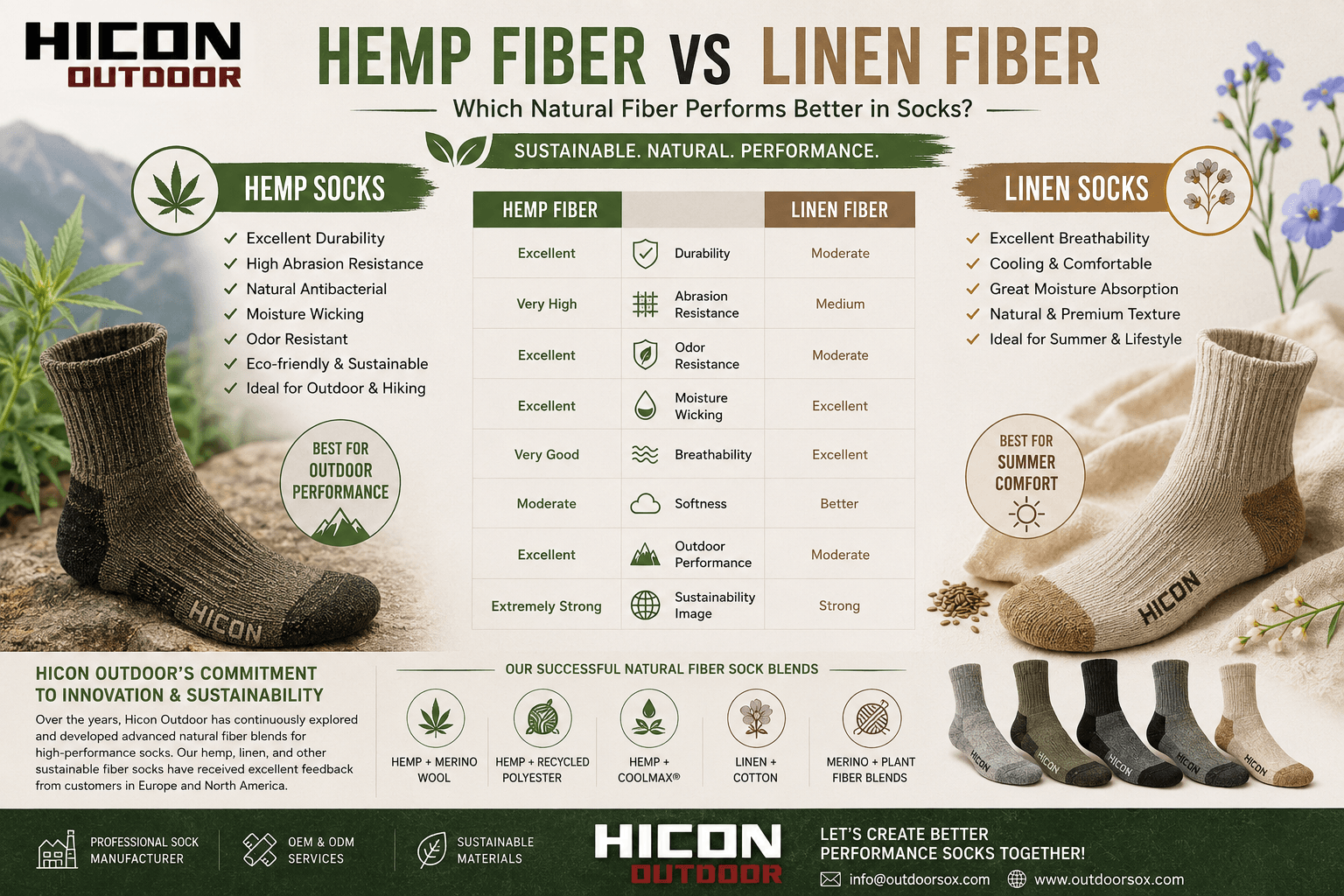
Although both are natural bast fibers, their behavior in sock knitting is very different.
| Property | Hemp Fiber Socks | Linen Fiber Socks |
|---|---|---|
| Durability | Excellent | Moderate |
| Abrasion Resistance | Very High | Medium |
| Moisture Wicking | Excellent | Excellent |
| Breathability | Very Good | Excellent |
| Odor Resistance | Excellent | Moderate |
| Softness | Moderate | Better |
| Cooling Effect | Good | Excellent |
| Outdoor Performance | Excellent | Moderate |
| Sustainability Image | Extremely Strong | Strong |
| Sock Knitting Stability | Better | More Difficult |
Why Hemp Fiber is Growing Rapidly in Outdoor Socks
In recent years, hemp fiber has become one of the fastest-growing natural fibers in the performance sock market.
Many consumers associate hemp products with:
- Eco-friendly lifestyles
- Sustainable fashion
- Natural functionality
- Outdoor performance
Hemp socks are increasingly used in:
- Hiking socks
- Trekking socks
- Work socks
- Tactical socks
- Outdoor performance socks
The reason is simple:
Hemp Performs Extremely Well Under Repeated Friction
Unlike many natural fibers, hemp fiber offers exceptional resistance to wear and deformation. This is particularly important in sock applications because socks experience:
- Continuous stretching
- High friction inside footwear
- Repeated washing
- Moisture exposure
Compared with linen, hemp fibers maintain structural stability much better in heel and toe areas.
Studies and market observations also show hemp socks are valued for their natural odor resistance, antibacterial behavior, and moisture management.
Why Linen Socks Remain a Niche Market
Linen socks do have unique advantages.
The cooling sensation of linen is excellent, making it attractive for:
- Summer casual socks
- Lightweight dress socks
- Lifestyle collections
However, linen fibers also present several limitations in performance socks:
- Lower abrasion resistance
- Lower elasticity recovery
- Easier yarn breakage during knitting
- Reduced durability under outdoor use
For this reason, linen socks remain relatively niche compared with hemp-based performance socks.
In most cases, linen works better as a comfort-enhancing blend fiber rather than a primary structural performance fiber.
Hicon Outdoor’s Continuous Exploration of Sustainable Fiber Socks
At Hicon Outdoor, we believe innovation in sock manufacturing starts with material engineering.
Over the past several years, the Hicon Team has continuously explored the integration of natural and sustainable fibers into functional sock development.
We have successfully developed and commercialized various sustainable blend constructions, including:
- Hemp + Merino Wool
- Hemp + Recycled Polyester
- Hemp + Coolmax®
- Linen + Cotton
- Merino + Natural Plant Fibers
These advanced yarn combinations help balance:
- Comfort
- Durability
- Moisture control
- Sustainability
- Outdoor performance
Our hemp blend socks, especially Hemp + Merino hiking socks, have received very positive feedback from customers in Europe and North America, particularly in outdoor and eco-conscious retail markets.
Many buyers appreciate the combination of:
- Natural antibacterial performance
- Reduced odor retention
- Enhanced durability
- Sustainable storytelling
- Premium natural hand feel
As sustainability becomes a key purchasing factor in global textile sourcing, hemp-based sock collections continue to show strong market potential.
The Future of Sustainable Outdoor Socks
The future of socks is no longer purely synthetic.
Consumers increasingly demand products that combine:
- Technical performance
- Natural comfort
- Environmental responsibility
Hemp fiber is uniquely positioned to meet these expectations because it combines sustainability with genuine functional performance.
At Hicon Outdoor, we expect continued growth in:
- Hemp hiking socks
- Hemp work socks
- Hemp Merino socks
- Sustainable outdoor sock collections
As a professional outdoor sock manufacturer, we will continue investing in functional yarn innovation and sustainable sock engineering to support global brands seeking next-generation natural performance socks.
Final Thoughts
Both hemp fiber and linen fiber have their place in modern sock development.
However, for outdoor performance socks, hemp fiber clearly offers broader advantages in:
- Durability
- Odor resistance
- Abrasion performance
- Sustainability positioning
- Functional outdoor applications
Linen remains an excellent choice for lightweight summer and lifestyle socks, while hemp is rapidly becoming a preferred fiber for high-performance sustainable socks.
At Hicon Outdoor, we are proud to continue exploring innovative natural fiber technologies and bringing sustainable functional sock solutions to customers worldwide.
For OEM & ODM inquiries: info@outdoorsox.com
Post time: May-22-2026