Outdoor enthusiasts often view Merino wool as the ultimate performance fiber. It is soft, naturally breathable, temperature-regulating, and highly resistant to odor. These qualities have made Merino wool a cornerstone material in premium hiking socks, trekking socks, ski socks, and outdoor apparel.
However, despite its many advantages, Merino wool is not a perfect fiber.
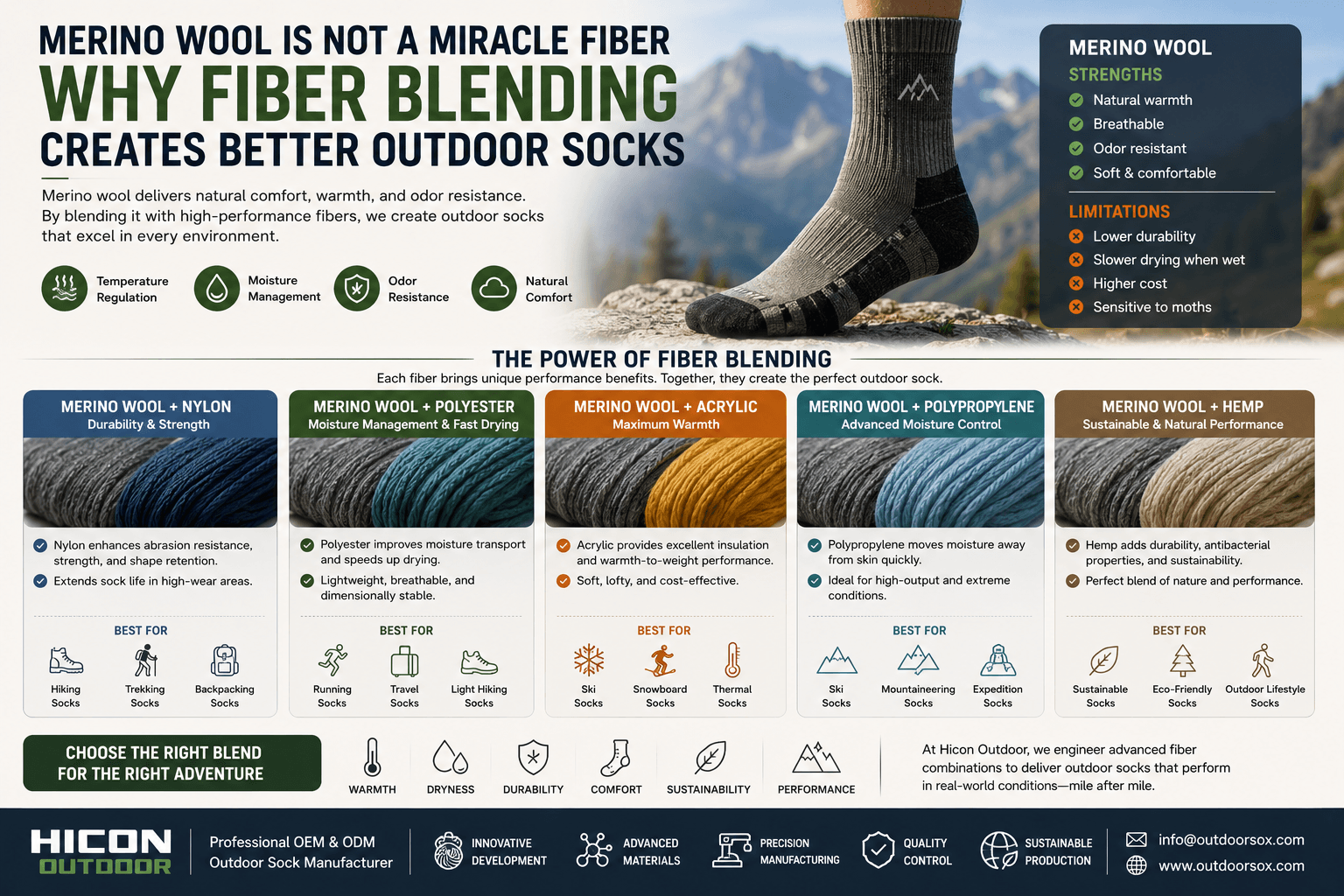
In reality, the world’s leading outdoor sock brands rarely use 100% Merino wool constructions. Instead, they strategically combine Merino wool with technical fibers such as nylon, polyester, acrylic, polypropylene, and hemp to enhance durability, moisture management, thermal performance, and sustainability.
At Hicon Outdoor, we believe that great outdoor socks are not built around a single fiber. They are engineered through intelligent fiber blending, where every yarn contributes a specific performance benefit.
This philosophy has guided our development of hundreds of hiking, trekking, skiing, and outdoor sock designs for global brands.
Why Merino Wool Remains the Foundation of Premium Outdoor Socks
Merino wool continues to be one of the most valuable fibers in outdoor performance products because it offers a unique combination of natural benefits.
Natural Temperature Regulation
Merino wool helps maintain a comfortable microclimate around the foot by trapping warmth in cold conditions while allowing excess heat to escape during activity.
This makes it ideal for:
- Hiking Socks
- Trekking Socks
- Ski Socks
- Mountaineering Socks
- Winter Outdoor Socks
Excellent Moisture Management
Merino wool can absorb moisture vapor while remaining comfortable against the skin.
Benefits include:
- Reduced clamminess
- Improved comfort
- Better thermal stability
- Enhanced wearability during long outdoor activities
Natural Odor Resistance
One of the most appreciated characteristics of Merino wool is its ability to resist odor-causing bacteria.
For multi-day hiking, trekking, and travel, Merino wool remains one of the best natural fibers available.
Softness and Comfort
Modern fine-gauge Merino wool provides exceptional next-to-skin comfort and minimizes irritation, making it suitable for extended wear.
The Limitations of Merino Wool
Despite its impressive performance, Merino wool has several inherent weaknesses.
Limited Durability
Compared with synthetic fibers, wool fibers are more susceptible to:
- Abrasion
- Surface fuzzing
- Pilling
- Fiber breakage
This is particularly noticeable in high-friction sock zones such as:
- Heel
- Toe
- Ball of Foot
Slower Drying Speed
Although wool manages moisture well, it does not dry as quickly as many synthetic fibers.
During prolonged wet conditions, faster-drying fibers may offer advantages.
Higher Cost
Premium Merino wool is significantly more expensive than most synthetic alternatives.
For many outdoor brands, balancing performance and cost is an important consideration.
Why Fiber Blending Matters
At Hicon Outdoor, we view Merino wool as the foundation—not the complete solution.
By combining Merino wool with complementary fibers, we can create socks optimized for specific outdoor environments and activities.
Merino Wool + Nylon: The Industry Standard for Durability
The most common blend in premium hiking and trekking socks is:
Merino Wool + Nylon
Nylon contributes:
- Exceptional abrasion resistance
- Increased tensile strength
- Better shape retention
- Longer product lifespan
Meanwhile, Merino wool provides:
- Comfort
- Thermoregulation
- Odor control
This combination is widely used by leading outdoor brands because it creates an excellent balance between comfort and durability.
Best Applications
- Hiking Socks
- Trekking Socks
- Backpacking Socks
- Everyday Outdoor Socks
Merino Wool + Polyester: Enhanced Moisture Management
Polyester brings different advantages.
Compared with nylon, polyester excels in:
- Moisture transport
- Fast drying
- Lightweight performance
- Dimensional stability
This blend works particularly well for:
Best Applications
- Lightweight Hiking Socks
- Running Socks
- Travel Socks
- Active Outdoor Socks
For users who prioritize quick drying and lightweight comfort, Merino-polyester blends are often an excellent choice.
Merino Wool + Acrylic: Maximum Warmth for Winter Sports
Acrylic remains one of the most effective synthetic fibers for thermal insulation.
Its naturally bulky structure traps warm air efficiently and creates excellent warmth-to-weight performance.
Advantages
- Lightweight warmth
- Soft hand feel
- Excellent loft
- Cost-effective insulation
Best Applications
- Ski Socks
- Snowboard Socks
- Thermal Socks
- Winter Outdoor Socks
Many high-performance winter socks rely on Merino-acrylic blends to achieve both warmth and comfort.
Merino Wool + Polypropylene: Advanced Moisture Control
Polypropylene is one of the most technically interesting fibers used in performance socks.
Its moisture absorption rate is nearly zero.
This allows polypropylene to:
- Move moisture away from the skin rapidly
- Keep feet drier
- Reduce heat loss caused by perspiration
Many technical ski and mountaineering socks use polypropylene in the inner layer and Merino wool in the outer layer.
This creates an efficient moisture transfer system:
Skin → Polypropylene → Merino Wool → Environment
Best Applications
- Ski Socks
- Mountaineering Socks
- Expedition Socks
- Extreme Cold Weather Socks
Merino Wool + Hemp: The Future of Sustainable Outdoor Socks
One of the most exciting developments in recent years is the combination of Merino wool and hemp fiber.
This blend brings together two natural performance fibers.
Merino Wool Provides
- Warmth
- Softness
- Odor resistance
- Moisture management
Hemp Provides
- Durability
- Natural antibacterial properties
- Sustainability
- Abrasion resistance
The result is a sock that performs exceptionally well while supporting growing consumer demand for environmentally responsible products.
Best Applications
- Sustainable Hiking Socks
- Eco-Friendly Trekking Socks
- Outdoor Lifestyle Socks
- Natural Fiber Performance Socks
At Hicon Outdoor, we have been actively exploring Merino-hemp constructions and have received highly positive feedback from customers in Europe and North America.
Choosing the Right Blend for the Right Activity
Different outdoor activities require different performance characteristics.
| Activity | Recommended Fiber Blend |
|---|---|
| Hiking Socks | Merino Wool + Nylon |
| Trekking Socks | Merino Wool + Nylon + Polypropylene |
| Ski Socks | Merino Wool + Acrylic |
| Running Socks | Merino Wool + Polyester |
| Sustainable Socks | Merino Wool + Hemp |
| Expedition Socks | Merino Wool + Polypropylene |
There is no single “perfect fiber.”
The perfect sock comes from selecting the right blend for the intended use.
Hicon Outdoor’s Fiber Engineering Philosophy
At Hicon Outdoor, we do not believe in a one-fiber-fits-all approach.
Instead, we focus on engineering high-performance yarn combinations that maximize:
- Comfort
- Durability
- Moisture management
- Thermal efficiency
- Sustainability
- Long-term performance
Our development team continuously works with:
- RWS-Certified Merino Wool
- Nylon
- Polyester
- Acrylic
- Polypropylene
- Hemp Fiber
- Recycled Fibers
- Technical Stretch Yarns
to create innovative sock solutions for outdoor brands worldwide.
Each year, we develop hundreds of new sock constructions designed specifically for hiking, trekking, skiing, running, and outdoor adventures.
Conclusion
Merino wool is one of the finest natural fibers available for outdoor socks, but it is not a miracle fiber.
Its true potential is unlocked when combined with complementary materials that address its natural limitations.
Whether the goal is durability, moisture management, warmth, sustainability, or extreme-weather performance, intelligent fiber blending creates socks that outperform single-fiber constructions.
At Hicon Outdoor, we believe the future of outdoor socks lies not in choosing between natural and technical fibers, but in combining them intelligently to create products that perform in real-world conditions.
Post time: Jun-16-2026