When consumers purchase a pair of premium Merino wool hiking socks, ski socks, or outdoor performance socks, they often focus on comfort, warmth, and moisture management.
However, another remarkable feature of Merino wool is often overlooked:
Its exceptional ability to absorb and retain vibrant colors.
From deep mountain greens and rich charcoal greys to bright ski-inspired patterns and technical outdoor colorways, Merino wool has a unique relationship with dye molecules that makes it one of the most beautiful fibers in the textile industry.
At Hicon Outdoor, we work extensively with premium Merino wool yarns to develop hiking socks, ski socks, trekking socks, and outdoor performance socks for global brands. Understanding the science behind wool dyeing helps explain why high-quality Merino wool products maintain their appearance and color performance for years.
Let’s take a closer look inside the microscopic world of wool fibers.
Why Wool Accepts Dye So Well
Unlike synthetic fibers, wool is a natural protein fiber.
Each wool fiber is built from keratin proteins containing numerous amino acid groups that can interact with dye molecules.
This protein-based structure gives wool a significant advantage during dyeing:
- Excellent dye affinity
- Rich color depth
- High color saturation
- Superior shade complexity
This is one reason why premium outdoor brands continue to favor Merino wool for performance socks and apparel.
The Unique Structure of Wool Fiber
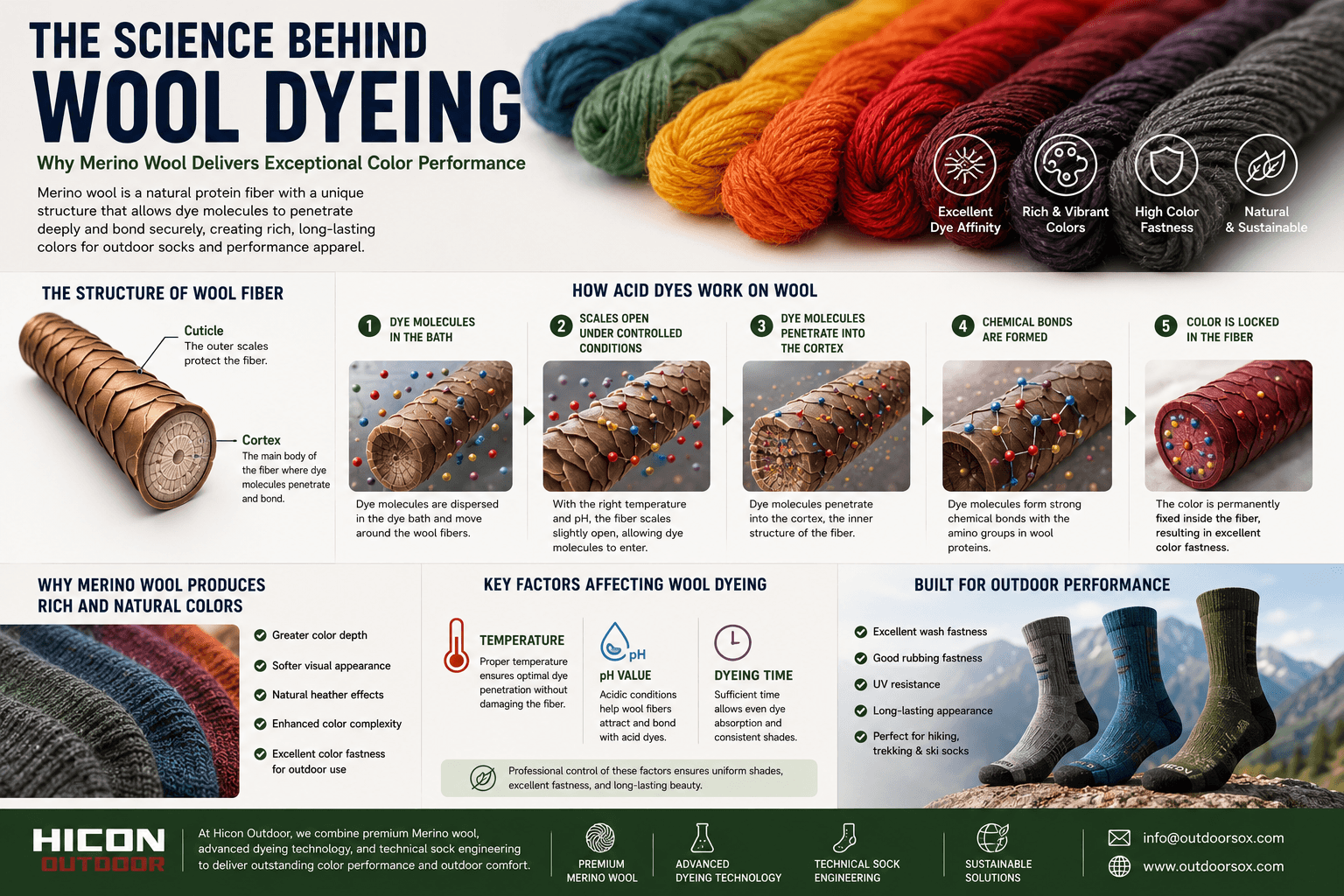
Under a microscope, wool fibers resemble overlapping roof tiles.
These tiny outer scales are known as the cuticle layer.
Beneath the cuticle lies the cortex, which forms the main body of the fiber.
During dyeing:
- Dye molecules move through the dye bath.
- The fiber scales slightly open under controlled conditions.
- Dye molecules penetrate into the fiber cortex.
- Chemical bonds form between dye molecules and wool proteins.
- Color becomes permanently fixed inside the fiber.
Unlike surface coating or pigment printing, wool dyeing creates color from within the fiber itself.
This contributes to excellent color richness and durability.
How Acid Dyes Work on Wool
Most Merino wool products are dyed using acid dyes.
The dyeing process involves:
- Controlled temperature
- Precise pH management
- Carefully selected dye chemistry
During dyeing, wool fibers become positively charged under acidic conditions.
Acid dyes carry negative charges.
This creates a strong attraction between:
- Dye molecules
- Wool amino groups
The result is a stable bond that helps produce excellent color fastness and long-lasting appearance.
The Importance of Temperature in Wool Dyeing
Temperature plays a critical role in dye penetration.
If the temperature is too low:
- Dye absorption may be incomplete.
- Color unevenness can occur.
If the temperature is too high:
- Fiber damage may occur.
- Excessive felting can develop.
Professional dye houses carefully control heating curves to ensure:
- Uniform dye penetration
- Consistent shades
- Fiber integrity
This process is especially important when producing premium Merino wool sock yarns for technical outdoor applications.
Why Merino Wool Produces Rich and Natural Colors
One reason Merino wool is highly valued in outdoor products is its ability to produce sophisticated color effects.
Compared with many synthetic fibers, wool often provides:
- Greater color depth
- Softer visual appearance
- Natural heather effects
- Enhanced color complexity
This allows designers to create premium outdoor aesthetics that align perfectly with modern hiking, trekking, and winter sports collections.
Color Fastness Matters in Outdoor Socks
Outdoor socks experience:
- Repeated washing
- Continuous friction
- Moisture exposure
- UV exposure
For this reason, color fastness is critical.
Properly dyed Merino wool socks offer:
- Excellent wash fastness
- Good rubbing fastness
- Long-lasting appearance
- Reduced fading over time
When combined with modern dyeing technology and quality-controlled production, premium Merino wool socks can maintain their appearance through many seasons of use.
Hicon Outdoor’s Approach to Merino Wool Color Development
At Hicon Outdoor, color development is an essential part of our OEM and ODM sock manufacturing process.
Our team works closely with yarn suppliers, dye houses, and outdoor brands to achieve:
- Accurate Pantone matching
- Consistent color reproduction
- Outdoor-inspired color palettes
- Sustainable dyeing solutions
- High color fastness standards
We regularly develop custom color programs for:
- Merino Hiking Socks
- Merino Ski Socks
- Compression Socks
- Outdoor Trekking Socks
- Sustainable Wool Sock Collections
By combining premium Merino wool with advanced dyeing technology, we help brands create products that deliver both technical performance and visual appeal.
Sustainability and Wool Dyeing
As the outdoor industry increasingly focuses on sustainability, modern wool dyeing technologies continue to evolve.
Many dye houses now implement:
- Water-saving systems
- Energy-efficient dyeing processes
- Improved wastewater treatment
- Responsible chemical management
When paired with renewable fibers such as RWS-certified Merino wool, these innovations contribute to a more sustainable textile supply chain.
Conclusion
The beauty of Merino wool goes far beyond softness and warmth.
Its unique protein structure allows dye molecules to penetrate deeply into the fiber, creating vibrant colors, excellent color fastness, and premium visual appeal.
For outdoor brands, this means the ability to create hiking socks, ski socks, and trekking socks that not only perform exceptionally well but also maintain their appearance season after season.
At Hicon Outdoor, we combine premium Merino wool, advanced dyeing expertise, and technical sock engineering to help global brands develop outdoor socks that look as good as they perform.
Post time: Jun-16-2026